Some might say that the following article is too pessimistic and they might be right. I however, think it's a dose of reality to all of us. I love this country but that does not mean I'm going to just buy into everything the government and especially this God awful administration is trying to get us to believe.
By David Michael Green
One day you're gonna wake up, America.
And, like every other one since last you can remember, it's gonna be an ugly morning.
One day you're gonna wake up and go to your lousy job with its lousy salary and non-existent benefits. You might even remember the good job you once had. Or that the government you once supported gave tax breaks to companies like the one that exported that good job of yours to the Third World (which is what they're now starting to call your country). Or that that same government undermined the labor unions which fought to get you your good wages and benefits.
One day you're gonna wake up and be furious at the monstrous tax burden you are carrying, a tab which accounts for fifty of the seventy hours you must work each week just to eke by. You might even figure out why your tax bill is so high. You might remember that the government you once supported shifted the tax burden from the rich onto people like you, and from the taxpayers of the time onto those of today. And that they borrowed money in astonishing quantities to fund their sleight-of-hand, so that you work thirty hours a week just to pay the interest on a mountain of money borrowed decades ago.
One day you're gonna wake up in anger at the absurdly poor education your children are receiving. You're gonna remember that it wasn't always that way, that even after the military's voracious appetite was temporarily sated, your country still managed to find a few bucks to at least educate a workforce. No more. And you're gonna remember how you applauded when your educational system was twisted in to a test taking industry that is careful, above all, not to teach children how to think.
One day you're gonna wake up literally sick and tired. You're gonna want treatment for your maladies but you won't be able to touch the cost. You're gonna wonder what you were thinking when believed your country had the best health care system in the world, even though it was the only advanced democracy in the world that didn't provide universal care, even though it devoted fifty percent more of its economy than those other countries to pay for a system that left fifty million people uninsured, and even though there were massive layers of unnecessary and harmful private sector bureaucracy skimming hundreds of billions of dollars of profits out of the system in the name of free enterprise.
One day you're gonna wake up too tired to go to work anymore. You're gonna want to retire in dignity but will be left instead to laugh bitterly at the cruelty of that joke. And you're gonna wonder what in the world you had been thinking voting for a president who's primary goal was to allow Wall Street to raid Social Security, destroying what had once been considered the most successful domestic program in human history.
One day you're gonna wake up and wish that it wasn't so bloody hot, and that there weren't so many diseases and species eradications and violent storms lashing the planet. And maybe you'll even remember that you once supported a government that lied about the very existence of global warming - back when it might have been curtailed - a government that scuttled the barest remedy for the problem in order to protect oil company profits.
One day you're gonna wake up and wish you had a government that could simply and competently do the basic things it was designed for. A government that could protect you from foreign attack, that could come to your rescue after a devastating hurricane, that could properly manage a new program or other people's security. An administration that didn't pervert the purpose of every agency within the government to its opposite, using civil rights lawyers to fight civil rights, for example, or the EPA to protect polluters.
One day you're gonna wake up and cry out for simple justice, blindly applied without bias. And perhaps you'll remember when that principle died. When your country stood by and watched the politicization of its judicial system for purposes of partisanship, and said nothing. When it stood by and watched its highest law enforcement officials in the land lie about their failing memory of events and pretended to believe that was acceptable.
One day you're gonna wake up and wish that you weren't being drafted to go fight wars you don't believe in. You'll remember how soldiers were sent to their deaths for lies. You'll remember how badly they were treated when they came home maimed and twisted. You'll remember how real, patriotic, former soldiers were mocked and humiliated by dress-up, unpatriotic, former non-soldiers. And suddenly you'll understand why no one would volunteer for the military anymore, and why people like you had to be drafted.
One day you're gonna wake up and want very badly to run outside and scream in anger about a government that long ago stopped serving your interests in favor of the narrow interests of a tiny oligarchy. But instead you'll stay inside and keep your scream tucked safely in your belly. Because you'll know that in your country dissent has long since been outlawed, on pain of torture and death. You'll remember concepts like due process, limitations on government search, seizure and wiretapping, habeas corpus, trial by peers, legal representation and prohibitions against cruel and unusual punishment as historical artifacts no longer even taught in schools.
On day you're gonna wake up and want so badly to change governments. You're gonna treasure the concept of democracy like no Soviet dissident ever did. You're gonna crave the opportunity to own your own government, to make your own societal choices, to make a change of direction never before so desperately necessary. And you're gonna wonder why you didn't speak up as you watched first-hand the dismantling of the democracy you had been handed by previous generations of patriots. You're gonna wish you had been patriotic enough yourself to demand, above all else, free and fair elections, and you're gonna shake your head in puzzlement at how you stood by watching in silence those that patently were not.
One day you're gonna wake up and want to get the hell out of your rotting, repressive country. You're gonna remember a time when that wasn't true. But, oddly enough, you'll find that other countries remember too. They'll remember your country's arrogance, its unilateralism, its walls, its racism, and its politicized abuse of immigrants. And they'll remember how your government undermined and violently replaced theirs whenever corporations from your country had their profits threatened. You're gonna want to leave, but there will be nowhere you'll be welcome. You're gonna find out that walls can face both directions.
One day you're gonna wake up in a hostile world where your country no longer has any friends. There will be governments of other countries - former long-standing allies - that cannot afford to have anything to do with you, lest their publics angrily remove them from office for collaborating with a country as hated as yours. Nor will those governments trust yours anyway. They will perhaps possess intelligence that could save your life, but they will not share it. They will possess forces that could help you survive real security threats, but they will not provide them. Your country will have become an international pariah, the South Africa of the twenty-first century.
And because no one will assist you, one day you're gonna wake up fearing for your life as your country is brutally attacked by angry militants deploying weapons of mass destruction against your cities. Long dormant connections in your brain will resurface, and you will dimly understand why. On this day - perhaps March 20, 2023 - you might be assisted in your comprehension by the message of one of the attackers, someone whose family your country callously destroyed in its mission accomplished in Iraq, and who spent the next twenty years plotting this day's revenge. And you will wonder again why you stood by as your country attacked Iraq on a completely bogus pretext. You'll remember applauding when this mailed fist was long ago sent. And, just as it comes hurling back in your direction at a lethal velocity, stamped "Return to Sender", you'll wonder what you were thinking. And you'll realize just how much you weren't.
One day you're gonna wake up, America, and you're gonna find out what was happening while you were sprawled on the couch watching endless mind-numbing loops of CSI, Desperate Housewives or Dancing with the Stars.
One day you're gonna wake up and realize that catching all the action during week seven of the 2011 NFL season really wasn't so critical in the greater scheme of things after all.
One day you're gonna wake up and wished you'd invested a little more energy into monitoring and choosing the people who made monumental decisions on your behalf.
One day, with a flash of remorse greater than you thought it possible that one human vessel could contain, you'll remember the ignored warning shots across your bow. Moments later, you'll discover the human capacity for searing remorse is actually even greater still, as you contemplate your inattention even to the shots that were fired right through the bow. With a fury you would yesterday have thought yourself incapable of, you'll hurriedly attempt to affix Band-Aids to the tattered splinters remaining from your country's once sturdy hull. But you'll learn quickly the toll of those years spent wasted in a civic coma. You'll find that no amount of patchwork can any longer save this sinking ship from its appointment with the dustbin of history.
In shame, you'll regret the callous arrogance with which you laughingly dismissed those who sounded the early clarion call. "We are destroying ourselves", they tried to tell you. But even on the rare occasion when you roused yourself from your stupor long enough to learn the slightest bit about the very threats that jeopardized your life and that of your species, still you found it more reassuring to follow the blustering worst amongst us, with their patently absurd pretended confidence, and their ever constant resort to the cheapest of false solutions, and the rudest of demeanors.
One day, you'll desperately search for hope of any sort, but none will remain. Nothing will be left to save you.
One day you'll realize that once there were solutions, but that that day is now long past. You'll see that human technological capacity ran its evolutionary race with wisdom, and the latter came in second. You'll sadly realize that you stood by while your country led the once great tool-making species to its own destruction.
One day you're gonna wake up, America, and realize how far it's all gone. But if that day isn't very soon, it won't matter.
Because one day you're gonna wake up, and it will be far, far too late.
Friday, May 04, 2007

Monday, April 30, 2007
Coastal hatcheries?....Close 'em !!!
I've touched on this before and apparently the spectre of the Trask and Salmon River hatcheries closing has raised it's head again.
Oh those harvest minded folks in Tillamook county and participants of the most popular gear fishing website will cry "foul". No doubt certain Tillamook county good old boys will try to rally the troops against these closures because it may interfere with their pet projects....well to damn bad!

Coastal hatcheries, specifically the ones in Tillamook county are the models of waste and inefficiency. The deferred maintenance costs have made these hatcheries outdated and obsolete and they should be razzed into non-existence. This is the opportunity to finally rid ourselves of the stream polluting money holes these facilities have become.
Remember the cry and outrage from a few years ago about these same hatcheries? This time let's close them and if Tillamook county just has to have it's hatchery raised salmon and steelhead then those eggs can be reared by some other facility.
Myself, I would like to see an end to all hatcheries on the north coast and the wild spawning populations given a chance to rebound so this may be the opportunity for those wild fish to do just that.
I would rather see that Oregon general fund money that was spent on these wasteful hatcheries be spent on wild fish enhancement projects and habitat restoration instead of making sure guides have fish to harvest during the later winter months where historically they've never fished before until the steelhead broodstock programs were started. Let's close the coastal rivers in the heat of the summer and put an end to the ridiculous summer steelhead hatchery plants where the vast majority of fish go unharvested and so since that is the case then why even bother to keep pouring money into that program?
When you get right down to it the selfishness and greed of some is what keeps these programs afloat and it's my opinion that it's time to end it.
Oh those harvest minded folks in Tillamook county and participants of the most popular gear fishing website will cry "foul". No doubt certain Tillamook county good old boys will try to rally the troops against these closures because it may interfere with their pet projects....well to damn bad!
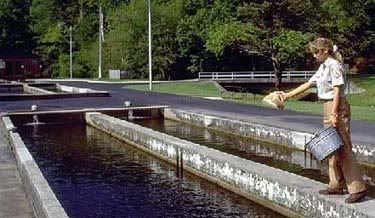
Coastal hatcheries, specifically the ones in Tillamook county are the models of waste and inefficiency. The deferred maintenance costs have made these hatcheries outdated and obsolete and they should be razzed into non-existence. This is the opportunity to finally rid ourselves of the stream polluting money holes these facilities have become.
Remember the cry and outrage from a few years ago about these same hatcheries? This time let's close them and if Tillamook county just has to have it's hatchery raised salmon and steelhead then those eggs can be reared by some other facility.
Myself, I would like to see an end to all hatcheries on the north coast and the wild spawning populations given a chance to rebound so this may be the opportunity for those wild fish to do just that.
I would rather see that Oregon general fund money that was spent on these wasteful hatcheries be spent on wild fish enhancement projects and habitat restoration instead of making sure guides have fish to harvest during the later winter months where historically they've never fished before until the steelhead broodstock programs were started. Let's close the coastal rivers in the heat of the summer and put an end to the ridiculous summer steelhead hatchery plants where the vast majority of fish go unharvested and so since that is the case then why even bother to keep pouring money into that program?
When you get right down to it the selfishness and greed of some is what keeps these programs afloat and it's my opinion that it's time to end it.
Sunday, April 22, 2007
Happy Earth Day
Here we are some 37 years after the first earth day in 1970. Have we made progress in those 37 years? Maybe some but it's for sure that we have a long ways to go. Face it folks global warming is a fact! It's inescapable and irrefutable and most of all it's not political. Unfortunately those who believe that the earth is our "whore" to screw at our pleasure will not accept the fact that we have contributed greatly to global warming. Why is it we, as Americans, think we have all the answers and we know what is best for the entire world? Surely there must be other smart people in other countries! Well the Bush administration made it very clear from the beginning that our environmental laws are fine as long as they don't keep multinational corporations from making billions.

Oh they use cute sayings like "Clean Water Initiative" and other deceptive sayings but the fact remains that this administration continues to try to water down the ESA, propose the opening of the Arctic Wildlife Refuge for oil drilling and open national forest for logging and roads not to mention not listening to sound environmental science.
The battle for the Metolius is just another example of what is happening for the sake of profit.
I happen to think out rivers and lakes and wilderness areas are our gift to our children and grandchildren and so doesn't it make sense to do all we can to protect them? We owe it to them.

Oh they use cute sayings like "Clean Water Initiative" and other deceptive sayings but the fact remains that this administration continues to try to water down the ESA, propose the opening of the Arctic Wildlife Refuge for oil drilling and open national forest for logging and roads not to mention not listening to sound environmental science.
The battle for the Metolius is just another example of what is happening for the sake of profit.
I happen to think out rivers and lakes and wilderness areas are our gift to our children and grandchildren and so doesn't it make sense to do all we can to protect them? We owe it to them.
The Quiet Pool Moment of Adorable
I've been pretty preachy as of late because of the various issues that are important to me so it's time for a moment of unadulterated cuteness.
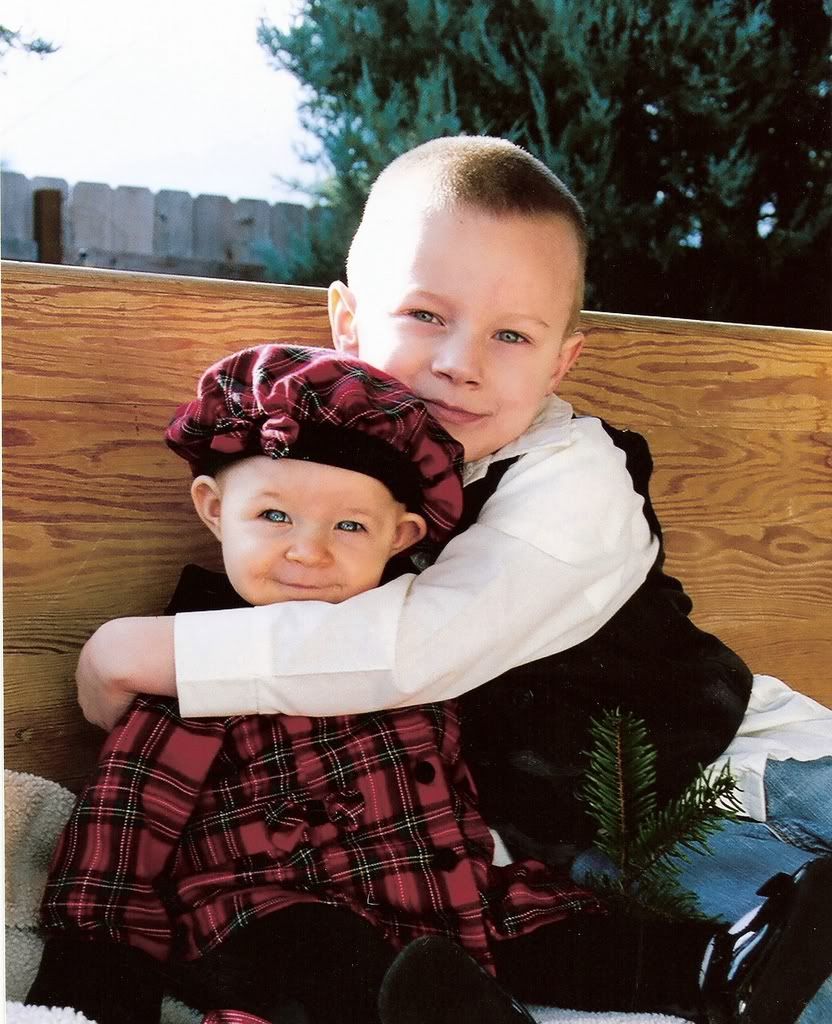
Here are two of my grandchildren. Conner Allan Stewart and Heidi Anne Stewart who is proudly wearing the family tartan by the way. They live in far off Medford, Oregon and we don't get to see them as much as we would like but this coming Memorial Day we will.
I'll bet those of you that know me think that there is nothing that can melt my gruff old heart..... Well these two can

Here are two of my grandchildren. Conner Allan Stewart and Heidi Anne Stewart who is proudly wearing the family tartan by the way. They live in far off Medford, Oregon and we don't get to see them as much as we would like but this coming Memorial Day we will.
I'll bet those of you that know me think that there is nothing that can melt my gruff old heart..... Well these two can
Saturday, April 14, 2007
Our Responsibility

North Fork Umpua River looking upstream from Mott Bridge
I've been thinking about this topic for quite awhile and just couldn't get into words what I wanted to say.
Do we, as anglers and outdoor enthusiasts, have a responsibility to be good stewards over the natural resources we enjoy? Or are we just users of that resource, never putting anything back.
I know as for myself I could do a lot more than I do. I could spend the day cleaning up stream side garbage or donating money to groups that fight for what we take for granted. I, as a retired person, could volunteer more of my time to the things I hold dear.
I believe we Americans have what I call the "Costco" mentality. Those of you that have shopped at Costco know what I am talking about if you've ever been there on a busy Saturday afternoon. We see aisle after aisle of all this merchandise and it's too much for our senses to take in. We feel we better push and shove in order to get all we think we need or are entitled to because it just may not be there next week.
I see the same type of behavior when it comes to our rivers and lakes. We feel entitled to what is there like it's owed to us or something and therefore it's ours to plunder. Forget about doing anything to actually makes things better because it's our God given right to take all the earth has to offer.
That type of thinking is abhorrent! Anyone who thinks that has no soul as far as I'm concerned.
So go ahead and call me a salmon hugger or tree hugger or whatever but I happen to think that we have some places in this country and this world that are worth saving! Places that should be preserved and not looked upon as a way to generate revenue and make some international corporation wealthy.
Ask yourself this...do you have just a little time or even money to give back to the things in the outdoors that mean so much? Or are you just a user and feel it's all owed to you?
Thursday, April 12, 2007
Save The Metolius....Update
I wrote my state senator Bruce W. Starr and asked him to support SB30 which would prohibit the construction of destination resorts within the Metolius basin and here is the response I got from him.
Dear Shane,
Thank you for the email.
I am hesitant to support SB 30 and bypass the local process that
is currently underway. I appreciate your writing and will watch the
bill. It may be amended and I could modify my view of the bill.
Sincerely,
Bruce W. Starr
Oregon State Senate
District 15
Here is my response back to him
Thank you for responding Sen. Starr but I cannot agree that this should be handled on the local level. Apparently the local county government is the one trying to push these zoning changes in order to accommodate the construction of these destination resorts. The Metolius is one of the real special places in Oregon and it would be a shame to see it ruined for the sake of a golf course and resort. The general public in Oregon cannot afford to stay at Central Oregon resorts like Sun River or Black Butte Ranch but the natural beauty of the Metolius basin is something everyone can enjoy. I urge again to please consider supporting SB30.
Sincerely,
Shane Stewart
Hillsboro, OR.
Being the son of a former republican state senator Charles Starr and land owner here in Washington County I did not expect much from Sen. Starr and so I was not disappointed. His father did a lot of zoning law hocus-pocus and I expect no different from the son.
By letting the local Jefferson County government settle this he is basically giving his blessing to what they are trying to do.
Any of you that love this river and wilderness area should contact your state senator and express your concern.

Dear Shane,
Thank you for the email.
I am hesitant to support SB 30 and bypass the local process that
is currently underway. I appreciate your writing and will watch the
bill. It may be amended and I could modify my view of the bill.
Sincerely,
Bruce W. Starr
Oregon State Senate
District 15
Here is my response back to him
Thank you for responding Sen. Starr but I cannot agree that this should be handled on the local level. Apparently the local county government is the one trying to push these zoning changes in order to accommodate the construction of these destination resorts. The Metolius is one of the real special places in Oregon and it would be a shame to see it ruined for the sake of a golf course and resort. The general public in Oregon cannot afford to stay at Central Oregon resorts like Sun River or Black Butte Ranch but the natural beauty of the Metolius basin is something everyone can enjoy. I urge again to please consider supporting SB30.
Sincerely,
Shane Stewart
Hillsboro, OR.
Being the son of a former republican state senator Charles Starr and land owner here in Washington County I did not expect much from Sen. Starr and so I was not disappointed. His father did a lot of zoning law hocus-pocus and I expect no different from the son.
By letting the local Jefferson County government settle this he is basically giving his blessing to what they are trying to do.
Any of you that love this river and wilderness area should contact your state senator and express your concern.

Sunday, April 08, 2007
No More Wild Fish?

Were you guys aware of that? Gee I wish someone would have informed the rest of us ignorant people
Here are some quotes from gear/bait oriented NW fsihing website that shall remain nameless.
As far as I'm concerned, the descendants of the hatchery fish in the rivers are natives once again. I don't know that we should take fish from one river and put them in another, but I don't know how much that would hurt, either. I'm sure some natives find new rivers to spawn in naturally
It gets better folks! Here is more brilliance
So we should let all fish spawn in the rivers, triple our hatchery output and start eating everything. I can tell you fish with fins taste just like the ones without.
Then these pearls of wisdom
The hippies like to say wild fish are genetically different, and their right! boys and girls are genetically different, everybody is genetically different, but we are all the same species! its just a way to split hairs, and spin the truth. saying that hatchery fish are inferior and should be destroyed is insane, it just pushes an agenda. funny thing is if you look carefully their beliefs parallel those who want a "pure" or "superior" race, the same who believe people who suffer from genetic defects such as retardation do not deserve a chance. don't get me wrong, I'm in no way putting the same value on fish as humans, just trying to illustrate the same flawed thinking! but then again I know a few people lower than squawfish!!!
Forunately there are people out there that know better and are the voice of reason. The quote below is from someone within the same thread. It shows that there are some that believe in the importance of strong native fish populations.
Too imply that there are no longer native fish, is also pushing an agenda.
There are still native fish. There are watersheds/tribs that were never stocked. There are creeks and streams with wild native spawning fish.
And, you didn't say just salmon. There are most definitely native trout in this state and they are amazingly different and adapted to their river system.
If you stay focused only on the biggest rivers, the biggest producers, you might see more hatchery fish, cause that's where we focused hatcheries. The little waters are still there. They still have natives. I hope we will always have native fish.
So what point am I trying to make? Simply this! There is a lot of ignorant and uncaring people out there that think any natural resource is just ours to plunder as we see fit. That kind of thinking has gotten us to the where we are today. We are perched precariously on the cliff of extinction of native fish runs...sorry for the pessimism but there it is. If not for groups like Native Fish Society, Oregon Trout and others we would be plunging headlong over that cliff and into the abyss.
There are also a lot of uneducated folks out there that just don't know what is true or false.
We need to do our best to inform them and not let them fall for the lies those "arm chair" biologists try to spread.
Sorry for the preaching but this kind of stuff really get's my blood up.
Saturday, March 31, 2007
Save The Metolius
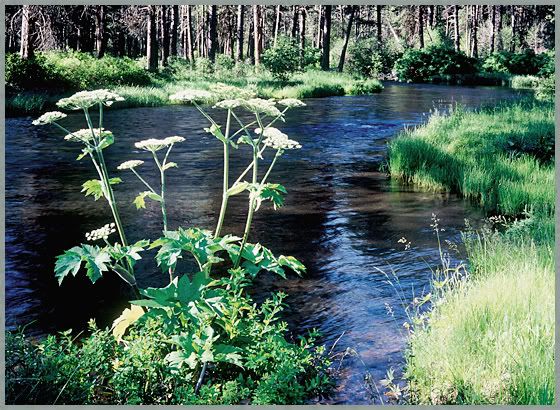
Any of you that have fished this river know what a special place it is. You can fish there and not touch a fish all day but feel like your day on the "Met" was one of your best days of fishing ever.The Metolius is just that kind of river!
So here we go again! Another threat by those with no soul and those who care for nothing but their pocket book! Friends we might as well face the fact that this kind of stuff is something we will always have to deal with as long as there is pristine and unspoiled waters.
The following is from Joel LaFollette's Royal Treatment Fly Fishing website
Once again greedy politicians are trying to steal from the public. This time it’s a group of county commissioner looking to cash in on county owned land in the Metolius basin. They’re proposing a sale of two pieces of county owned land for development into destination resorts. One piece of land rests on the hill on the east side of the Metolius basin. This is not where Oregon needs another golf course.
The Metolius basin is a special ecosystem that needs to be protected from this type of development. It is a fragile balancing act that nature has carried on for a millennium and we have already tipped the scales on more than one occasion. It has taken generations to understand how we affect our planet and the Metolius basin and the clear, cold river that flows through it have helped us with that understanding. We have learned that nature does a better job of fish production that we do. We have learned that water quality is important to all living things and is more expensive to restore than protect. We spend millions now to rebuild watersheds and the process takes time. Protection of a watershed offers instant results.
The environmental impact from water use, increased traffic, loss of habitat, chemical run off, increased fire danger and other issues make this a risky proposal for such a delicate area. It is not worth the risk. Jefferson County is facing hard times. Employers are moving out of the county and unemployment is high. Commissioners are looking for a quick fix. That’s not the right way to do anything. You just set yourself up to have to do it all over again the right way. It ends up costing much more. The number of family wage jobs destination resorts bring to an area is minimal. Housing for the workers willing to take the lower paying jobs doesn’t exist. You only have to go as far as Bend to see that there are not enough workers to fill those lower wage jobs. The cost of housing is too high to support a minimum wage work force.
The commissioners are really only looking to increase the county’s tax base. They are not really concerned with the employment picture of their county. Of course to the unemployed worker it seems like there is hope in this proposal, but it is false hope. There will be no winners if these proposed resorts are allowed to be built. In fact we will all lose. Oregonians will have lost one of the most special places in their state. All for a few pieces of fools gold.
For more information on what you can do go to www.savethemetolius.org
Sunday, March 25, 2007
The Joys of Trout...Cutthroat that is!
With apologies to Arnold Gingrich for plagiarizing the title of his classic fly fishing book I felt compelled to discuss with the myriad of you fans of the "Quiet Pool" why I am attracted to these fish!

First of all they are the last wild coastal trout on the west coast not counting Alaska. Very little is really known about their habits and whether some or maybe all try to migrate to saltwater. And just what do they do in salt water? Do they stay in the estuary or do the full ocean thing of their salmonid cousins. Again not much data there for us to cling to except for the volumes of information we do not know about these wonderful trout.
For you that have actively fly fished for them know the ferocity they will attack a fly whether it be on the surface or sub-surface or deeply sunk. For the life of me I cannot fathom the need to fish a deeply sunken fly for these fish but to each his own I guess.
What I do know is what they mean to me. They mean a warm summer evening on my favorite coastal tributary where I can lose myself pursuing them. I seldom see any one else fishing for them and that is just fine although I like nothing better than introducing other fly fishers to them....go figure!
They also mean the wistful end of summer when the leviathans of west coast fresh water fishing, namely chinook salmon, start their death journey up their rivers of birth.
It signals the end of the cutthroat season on the north coast and the beginning of the long dreary months of fall and winter in the Pacific Northwest. It's a time of year I dread and find myself getting nostalgic at that time of year because it also marks the conclusion of those warm days on the Deschutes.
So here I am about two or so months away from the Memorial Day opener. There won't be any big rush to the coast by the Portland Metro hordes (Thank God) but the fact that there are some who think this trout should be made harvestable makes me sick! As does those who think it's great sport to use bait and small hooks for these fish!
This winter I've seen many large and robust cutthroat trout as I pursue winter steelhead so that makes me optimistic for the coming season. So it's back to the tying bench because you never know how many Reverse Spiders I might need this year.

First of all they are the last wild coastal trout on the west coast not counting Alaska. Very little is really known about their habits and whether some or maybe all try to migrate to saltwater. And just what do they do in salt water? Do they stay in the estuary or do the full ocean thing of their salmonid cousins. Again not much data there for us to cling to except for the volumes of information we do not know about these wonderful trout.
For you that have actively fly fished for them know the ferocity they will attack a fly whether it be on the surface or sub-surface or deeply sunk. For the life of me I cannot fathom the need to fish a deeply sunken fly for these fish but to each his own I guess.
What I do know is what they mean to me. They mean a warm summer evening on my favorite coastal tributary where I can lose myself pursuing them. I seldom see any one else fishing for them and that is just fine although I like nothing better than introducing other fly fishers to them....go figure!
They also mean the wistful end of summer when the leviathans of west coast fresh water fishing, namely chinook salmon, start their death journey up their rivers of birth.
It signals the end of the cutthroat season on the north coast and the beginning of the long dreary months of fall and winter in the Pacific Northwest. It's a time of year I dread and find myself getting nostalgic at that time of year because it also marks the conclusion of those warm days on the Deschutes.
So here I am about two or so months away from the Memorial Day opener. There won't be any big rush to the coast by the Portland Metro hordes (Thank God) but the fact that there are some who think this trout should be made harvestable makes me sick! As does those who think it's great sport to use bait and small hooks for these fish!
This winter I've seen many large and robust cutthroat trout as I pursue winter steelhead so that makes me optimistic for the coming season. So it's back to the tying bench because you never know how many Reverse Spiders I might need this year.
Friday, March 16, 2007
It's So Close I Can Smell the Sage

Are we finally getting that taste of spring that the weatherman keeps promising? I can hardly wait for my first trip of the year over the mountain to the Deschutes. The long and dreary winter is hopefully behind us and now the real fishing for me begins.
I've gone out a few times this winter, mostly with conventional tackle and have managed a few hatchery steelhead that way and while it is fun it is not very satisfying due to the fact that I find it no challenge anymore. While I'm not claiming to be some gear fishing master I have been doing it during the winter for more years than I care to admit. It's an uninspiring way to fish and if my winter steelhead fly fishing skills were better then I would abandon it altogether. I have abandoned my pompous attitude towards them and started to fly fish with an indicator this year for winter steelhead so as I become more skilled at this technique I will put the gear back in mothballs.
All that aside it's spring now and what is so positive about that fact is the weather can only get better and I am excited about that! Rattlesnakes, locked gate and the Rainbow Tavern here I come.
Friday, February 23, 2007
A River Seen Right
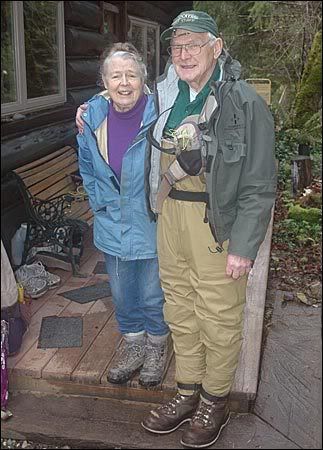
"A River Seen Right" is the title of a book about the North Fork of the Umpqua river that features a lot of stories about the former owner of the Steamboat Inn and true friend of the North Umpqua... Frank Moore.
Now those of you who use weighted flies, lead core line or conventional fishing gear probably do not think much of Mr. Moore especially those that fish the North Fork.
I think Frank Moore is one of the best friends the wild steelhead of the Umpqua ever had.
I met Mr. Moore last Saturday at the Fly Fishing Show in Portland and felt compelled to tell him that I really considered him a hero as far as wild fish and river conservation goes. My friend Don Nelson said he was a dear man! Pretty fitting tribute I would say.
We seem toss around the word "hero" maybe a little too much these days and that is especially true among the angling crowd. Because someone is a good fisherman and catches a lot of fish does not make that angler a hero! Webster's defines a hero as...a man admired for his achievements and noble qualities or one that shows great courage.
I think Frank Moore fits that definition perfectly and Bill Bakke is another. These heroes fought hard for what they believe in and that was the conservation of a precious river and it's wild fish. Had it not been for Mr. Moore the North Umpqua would be just another unremarkable river littered with monofilament and bait containers. He and others went against the conventional wisdom of the times to preserve this jewel among Oregon streams and I have no problem calling him a hero.
Thanks Frank for truly seeing a river right.
Thursday, February 15, 2007
Spring Is In the Air

Can there be any surer sign of spring than these glorious words?
"Pitchers and Catchers report on February 16th"
After the cold and gray days of winter and the boredom of the NFL it is time for the world to right itself once again. Yep baseball is almost here!!! Every team starts out full of hope and confidence of the coming season. None more truer than my beloved Los Angeles Dodgers, one of the lasting gifts my father left me is my love for this team. Not since that magic season of 1988 when a crippled Kirk Gibson achieved immortality has my Dodgers reached the promised land but...This is the year I just know it.
The lyrics from this classic song by John Fogerty says it all.
Centerfield
Well beat the drum and hold the phone
The sun came out today
We're born again, there's new grass on the field
A-roundin' third and headed for home
It's a brown-eyed handsome man
Anyone can understand the way I feel
Put me in Coach
I'm ready to play today
Put me in Coach
I'm ready to play today
Look at me
I can be
Centerfield
Well is spent some time in the Mudville Nine
Watchin' it from the bench
You know I took some lumps when the Mighty Case struck out
So say Hey Willie tell the Cobb
And Joe DiMaggio
Don't say it ain't so
You know the time is now
Put me in Coach
I'm ready to play today
Put me in Coach
I'm ready to play today
Look at me
I can be
Centerfield
Got a beat-up glove, a homemade bat,
And a brand new pair of shoes
You know I think it's time
To give this game a ride
Just to hit the ball and touch 'em all
A moment in the sun
It's gone and you can tell that one goodbye
Put me in Coach
I'm ready to play today
Put me in Coach
I'm ready to play today
Look at me
Gotta be
Centerfield
Friday, February 02, 2007
A Time For Tough Choices

Points to ponder to any of you that read this blog and also fish.
What are you willing to sacrifice for the betterment of the resource? Could you give up your fly fishing for trout on the Deschutes for instance? How about the wonderful coastal cutthroat trout on the north coast? How about those of you that fish the Columbia river for spring chinook?
The point I'm trying to make here is there very well may come a time when we face these tough choices. Face it folks the once abundant runs of wild anadromous fish are but a shell of their former selves. Over harvest, pollution, hydro-electric dams, gill nets and loss of habitat has decimated these runs to the point of extinction in many instances.
We can get outraged at the TV news footage of hungry pinnepeds devouring spring chinook salmon below Bonneville dam and rightly so to a degree. The thing is the problem is just a symptom of a much larger problem. The regions gluttony for hydro power necessitated these dams or so they tell us. So now we have the four nearly useless lower Snake River dams that serve no viable purpose other than blocking wild salmon escapement into spawning areas. Nearly everyone agrees that these dams could and should be removed but of course they have become sacred cows to those that think the earth is ours to plunder.
With man made climate changes and other man caused problems we may see the end to many endangered fish runs.
Not many people realize that the Pacific steelhead trout ranged as far south as Baja California! In just a couple of generations those runs are just a long gone memory. The extinction has crept up the coastline and the now virtually all wild spawning steelhead runs are in trouble.
Add to all this the mismanagement of the resource by state and federal agencies and therein lays the problem.
It's time to quit wasting our money with poorly designed and managed hatchery programs and spend that money where it will do the most good! We are not entitled to have fish to harvest and it is selfish to think so. Couldn't that money be better spent in wild fish habitat restoration?
A perfect example of wasted money is the shrine to logging in the Tillamook forest that was built along the Wilson river. It's a very impressive display of how the giant timber companies pillaged that forest for so many years. Do you think maybe those millions would have been better spent on the regions endangered wild fish? I think so.
This opinion is not popular among the "coastal" folk who make their living in the forest but can't we still harvest trees and keep our rivers and their wild fish viable? I think so!
Wednesday, January 24, 2007
An Angler's Winter and Other Laments

Last night it snowed for the first time, everything's covered in white. How many months till the springtime? It's a long winter's night
This winter has been especially tough for me with the seemingly endless nights and non-stop rain or snow. It put's on darkness on my moods that only the warmth of spring and summer can cure.
Part of it's been the fact that my beloved mother-in-law is no longer with us. She was the matriarch of the family and I never realized how much affection I had for her until she was gone. It's just not the same nor will it ever be but for the passing of time to heal the loss our family feels.
Secondly my fishing is not very adaptable for the winter. The trout don't rise after hatches that are not there because it's too cold.
My fly rods sit snugly in their cases and every once in awhile I'll take them out just to feel them in my hand. I know it's just a matter of a few months until the days are long enough and warm enough to venture over the mountains to seek the red sides of the Deschutes.
Oh I'll get out with my gear chucking friends and even fish some deeply swinging flies on a coastal river but it's not the same.
So with enthusiasm I will look to the coming spring with hope and anticipation.
Monday, January 15, 2007
Contamination leading to decline of Yellowstone Cutthroat Trout in Idaho
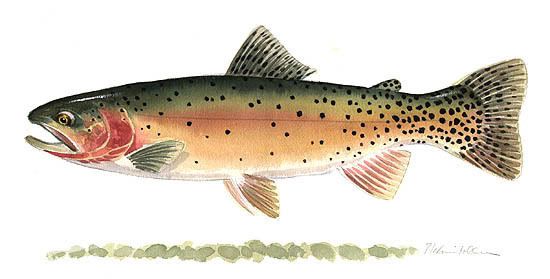
Once again man's greed and interference with the environment is exacting a heavy toll. This time with the endangered Yellowstone Cutthroat trout.
This article courtesy of the Moldy Chum blog.
KEITH RIDLER - The Associated Press
BOISE, Idaho -- Two of the West's largest remaining populations of Yellowstone cutthroat trout face sharp declines due to contamination from phosphate mines in southeast Idaho, Idaho State University professors say.
Rob Van Kirk, a professor who specializes in mathematical models of aquatic ecosystems, and Sheryl Hill, a biology professor, on Thursday released a study that predicts a precipitous fall of the prized game fish in some streams and an overall decline in populations in the region.
They said contamination comes from selenium leaching out of waste rock from the mines.
Selenium is a naturally occurring mineral that is healthy in small quantities but can build up to toxic levels. At phosphate mines, it leaches out of waste rock and accumulates in stream sediments, where it goes through the food chain from plants to insects to fish.
"The bottom line is there are (selenium) concentrations in fish that are high -- high by anyone's standards, not just cherry picking standards -- and that indicate a high risk of population declines," Van Kirk said.
The Bozeman, Mont.,-based Greater Yellowstone Association -- whose stated mission is to protect the lands, waters, and wildlife of the Greater Yellowstone Ecosystem -- paid the university about $8,600 to produce the report.
The organization is trying to collect expert data on how phosphate mines are effecting fish and wildlife, spokesman Marv Hoyt said.
The Blackfoot and Salt river drainages in southeast Idaho contain two of the six largest remaining populations of Yellowstone cutthroat, Van Kirk said.
The population has already suffered major setbacks in what was its main habitat, Yellowstone National Park, following illegal introduction of lake trout to Yellowstone Lake. In February, the U.S. Fish and Wildlife Service declined to list the species, though the selenium threat was considered.
"There were some concerns that were identified," said Wade Fredenberg, native fish coordinator with the wildlife service. "I don't want to trivialize it, because in those drainages it might be serious, but the point is we're not going to cease phosphate mining in every drainage that contains Yellowstone cutthroat trout."
Southeast Idaho contains large formations of phosphate rock. Phosphate is used for agricultural chemicals and fertilizer. Mining began in 1907 and increased significantly after World War II.
According to the coalition, the area has three operating phosphate mines and up to 26 closed mines. The main operators are Boise-based J.R. Simplot Co., Monsanto Co. in St. Louis and Agrium Inc. of Calgary. All three supply agricultural products to growers.
Fred Zerza, a Simplot spokesman, said the report from ISU was one of several designed to derail the company's planned expansion of its Smoky Canyon mine.
"This would be another in a succession of those," Zerza said, "to discredit the efforts of the company to develop the mine."
He said the company has made efforts to control selenium contamination with water and fish monitoring systems as well as rerouting one stream away from waste rock.
Researchers found that fish in the Salt and Blackfoot drainages contained an average 9.81 micrograms of selenium per gram of body weight, which they say is more than 2 micrograms above the point where fish populations start declining.
Of the 63 fish samples that looked at selenium levels, Van Kirk said most were taken in 2005 and 2006. The samples ranged from 1.8 micrograms up to 52.3 micrograms.
Four streams had concentrations above 20 micrograms, Van Kirk said, including East Mill Creek, a tributary to the Blackfoot River.
The Idaho Department of Health and Welfare has warned parents to limit the number of fish children eat from the creek because of the high selenium concentrations. But Van Kirk said selenium has killed most fish in that stream.
Three other streams that contained fish with levels above 20 micrograms were Sage, Deer and Crow creeks, all tributaries to the Salt River.
"It's scary," said Trout Unlimited Chris Hunt, based in Idaho Falls. "It's scary for us over here. These fish are the backbone of our fishery, up and down the east side of the state."
Van Kirk said more field work is needed.
"One of the requirements is that we get out and do some careful and well designed monitoring of the populations in the field," he said. "My guess is there is a lot more selenium that will continue to go into these streams."
Friday, December 29, 2006
The House of Hardy - Simply the Best

I have several Hardy fly reels and love them! They are unsurpassed in simple elegance and craftsmanship and I cannot imagine using another other reel with the exception of maybe a Bogdan or Peerless.
I've included a history of the House of Hardy for your reading pleasure.
All over the globe, there are people who love to fish and in the universal language of the sport, one name reigns supreme - that of Hardy. For well over a century, House of Hardy has been renowned as the manufacturer of the finest game fishing tackle in the world - the name is synonymous with quality and excellence. Such reputations are not acquired easily, but it has never faltered throughout the company's long history.
That history began in 1872, when William Hardy established himself as a gunsmith in his home town of Alnwick, Northumberland. A year later he was joined by his brother John James, and the Hardy Brothers Partnership came into being. The high quality guns sold ranged from shotguns to pistols. However, despite their success, the Hardy Brothers' passion for fishing soon dictated a change in direction. Their favourite hobby became their profession, and the reputation of Hardy rods and reels was born.
To begin with, lancewood, hickory and greenheart rods were produced, but by 1880, bamboo had been added to the range. The Company was the first manufacturer to invent a system for building rods in hexagonal form from bamboo. The Hardy Palakona bamboo rod won the Company's first exhibition gold medal in 1881. Hardy products only stopped winning when gold medals were no longer presented at such exhibitions.

In 1891, the first Hardy "Perfect" reel was patented. This design has stood the test of time, and although there have been one or two minor alterations, the same basic model is manufactured today. Throughout its history, the Company has been responsible for some of the most radical advances in tackle design. It was the first to market bridge rings, spiral lock-fast joints, stud-lock joints, split-end joints, and "W" and screw-grip fittings for Salmon and Trout rods. It developed ball bearing reels and was the first to feature the check mechanism housed within the reel arbor and introduced the first large arbour reel in 1911.

The Company's record of innovation is a testament to the wealth of expertise invested in it. Among the three generations of Hardys involved in the firm, there have been some great anglers, beginning with John James who became World Champion Fly Caster. His nephew "LRH" became the most celebrated fly fisherman of his day: his prowess in casting reached almost legendary proportions. James L Hardy (JLH), grandson of the founder William carried on the tradition in tournament casting. He held 25 British National Professional records, 10 British All-Comers Professional records and three times has been World Professional Champion Caster. Jim retired from the company in early 1992 and as a consultant assisted with product development; his long awaited history of the Hardy family was published in 1998.
Although for the majority of its history, House of Hardy has remained a family firm, its very success decreed that it would not remain a partnership for long. In 1907 it was incorporated as a Limited Company, and in 1928 it went public. In 1933, Hardy Brothers (Alnwick) Limited extended its operations to include golf club manufacture. However, although Hardy wooden golf clubs also reached a high level of acclaim, the venture was closed in 1935 with the advent of steel shafts onto the market. Instead, the Company established itself as the absolute specialist in fishing tackle. Notwithstanding a brief interlude during World War II when it produced munitions, the Company continued to expand its range.
Alnwick, England, became famous as the birthplace of this angling institution and the annual Hardy catalogue became the "bible" for all those who sought either knowledge of, or the best of fishing equipment itself - they have become very collectible items.
The list of Hardy devotees is as long as it is impressive. No less that 10 Royal Warrants of appointment, including those of the late King George V and the last three Princes of Wales have been awarded to Hardy during this last century.
In 1967 Hardy Brothers (Alnwick) Limited became a wholly owned subsidiary of the Harris & Sheldon Group Ltd.. A severe slump in the industry in the late 1970's eventually resulted in a three day week in 1983. This was the Company's nadir. In spite of the then difficult circumstances, the company survived, with its reputation intact and was the first to patent the graphite fly rod which surpassed fibreglass in performance.
A Hardy reel became the holder of the first American Kudos Award for Design Excellence; and in 1984, House of Hardy was the first non-Japanese manufacturer to receive a Japanese Industrial Design Award winning not one but five. In the same year, Hardy (USA) Inc, was established as a marketing subsidiary to handle the growing demand in the American angling market. In 1985, the company name was changed to "House of Hardy Limited" to encompass the new and extended activities. The following year, this exceptional record was rewarded when in April, 1986, the Company received the Queen's Award for Export Achievement.
To ensure that some of the fishing tackle memorabilia in the company's possession was preserved for posterity, House of Hardy then decided to build a museum at its Alnwick headquarters. This was opened by HRH The Princess Margaret in July, 1987, and is unique. Many of the exhibits have been lent by the company's many devotees round the world as well as by the Hardy family. The museum is half of an imposing complex which also houses the Hardy Country Store in which all current House of Hardy products are on permanent display and available to retail customers.
In September, 1988, House of Hardy acquired their manufacturer of quilted and waxed garments as part of Hardy's growing clothing division. Today, the CountryWear division produces a modern range of performance outerwear - including fleece jackets and shirts.
The third division of House of Hardy was the composite tubing business of Fibatube and has since been renamed Hardy Advanced Composites. At the leading edge of composite tube technology, the division had established an enviable reputation for innovation, design, quality, service and manufacturing expertise over 25 years. Many of the technical attributes required to produce the finest fishing rods have been utilised to supply tubular components for Formula 1 racing cars, artificial limbs and the A320 Airbus.
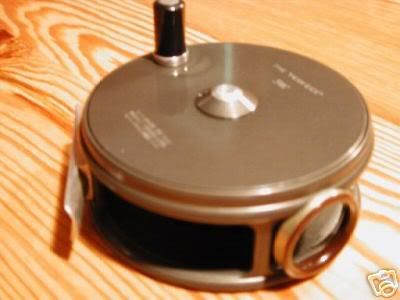
In the Alnwick factory, the company manufactures over 90% of all parts used in the Hardy range of fishing tackle - from split bamboo, glass and carbon fibre rods to the world's most extensive range of fly reels - as well as a comprehensive family of fishing accessories. Opposite St James Palace in London's Pall Mall, House of Hardy's retail shop has been a mecca for the world's game fishing enthusiasts for over 100 years. Now that Harry Potter films use the Alnwick Castle as the prime movie set, even more tourism is expected to discover Alnwick situated in the N. E. Corner of Northumberland near the Scottish border.
Friday, December 15, 2006
In Praise of Single Malts and Fine Cigars
Is there anything better? I mean to sit down with a nice single malt and perhaps a Monte Cristo while contemplating which Hardy Brothers fly reel is my latest object of desire. Honestly is there anything better to a 52 year old, over stuffed fly fisher like me?
My son got me a nice bottle of twelve year old Laphroaig for Christmas last year and it was not until June of this year when my dear mother in law passed away that I cracked the seal on it.I felt toasting her life was a fitting reason to open the bottle. Earlier in the year my good friend and bamboo guru Mike and I sat out on his deck and enjoyed a fifth of Spey Burn with a nice Monte Cristo to celebrate his new job after three years of unemployment.
When Mike finished my Dickerson taper 8013 we celebrated with a few rounds of Laphroaig that day too.
At this stage of my life there is very little that gets me real excited except maybe for a rising trout or a running steelhead so the simple pleasure of good whiskey, a good cigar and fly fishing does me just fine.
My son got me a nice bottle of twelve year old Laphroaig for Christmas last year and it was not until June of this year when my dear mother in law passed away that I cracked the seal on it.I felt toasting her life was a fitting reason to open the bottle. Earlier in the year my good friend and bamboo guru Mike and I sat out on his deck and enjoyed a fifth of Spey Burn with a nice Monte Cristo to celebrate his new job after three years of unemployment.
When Mike finished my Dickerson taper 8013 we celebrated with a few rounds of Laphroaig that day too.
At this stage of my life there is very little that gets me real excited except maybe for a rising trout or a running steelhead so the simple pleasure of good whiskey, a good cigar and fly fishing does me just fine.
Wednesday, November 29, 2006
The Dude Abides

I would like to dedicate today's posting to one of the greatest movies of all time!
There is undeniably a lot of wisdom to be gleaned from this epic motion picture.
Here is some of it...enjoy
The Stranger: [opening narrations] Way out west there was this fella I wanna tell ya' about. Goes by the name of Jeff Lebowski. At least that was the handle his loving parents gave him, but he never had much use for himself. See, this Lebowski, he called himself "The Dude". Now, Dude, there's a name no man would self-apply where I come from. But then there was a lot about the Dude that didn't make a whole lot of sense. And a lot about where he lived, like-wise. But then again, maybe that's why I found the place so darned' interestin'. See, they call Los Angeles the "City Of Angels", but I didn't find it to be that, exactly. But I'll allow it as there are some nice folks there. 'Course I aint never been to London, and I aint never seen France. And I aint never seen no queen in her damned undies, so the fella says. But I'll tell you what, after seeing Los Angeles, and this here story I'm about to unfold, well, I guess I seen somethin' every bit as stupefyin' as you'd seen in any of them other places. And in English, too. So I can with a smile on my face. Without feelin' like the good lord gipped me. Now this here story I'm about to unfold took place in the early nineties - just about the time of our conflict with Sad'm and the eye-rackies. I only mention it because sometimes there's a man, I wont say a hero, cause, what's a hero? Sometimes, there's a man. And I'm talkin' about the Dude here - The dude from Los Angeles. Sometimes, there's a man, well, he's the man for his time and place. He fits right in there. And that's the Dude. The Dude, from Los Angeles. And even if he's a lazy man, and the Dude was most certainly that. Quite possibly the laziest in all of Los Angeles County. Which would place him high in the runnin' for laziest worldwide. Sometimes there's a man, sometimes, there's a man. Well, I lost my train of thought here. But... aw, hell. I've done introduced it enough.
-----
The Big Lebowski: Is it being prepared to do the right thing, whatever the cost? Isn't that what makes a man?
The Dude: Sure, that and a pair of testicles.
-----
Jesus Quintana: Nobody fu**s with the Jesus!
-----
The Stranger: Just one thing, Dude.
The Dude: What's that?
The Stranger: Do you have to use so many cuss words?
The Dude: The fu** you talkin' 'bout?
-----
The Dude: Let me explain something to you. I am not Mr. Lebowski. You're Mr. Lebowski. I'm the Dude. So, that's what you call me. You know, that, or his dudeness, or duder, or el duderino, if you're not into the whole brevity thing.
-----
Walter Sobchak: You're entering a world of pain.
-----
Walter Sobchak: He's a sex offender, with a record. He did six months in Chino for exposing himself to an eight-year-old. When he moved to Hollywood he had to go door-to-door to tell everyone he was a pederast.
Donny: What's a "pederast," Walter?
Walter Sobchak: Shut the fu** up, Donny.
-----
Maude Lebowski: The word itself makes some men uncomfortable. Vagina.
The Dude: Oh yeah?
Maude Lebowski: Yes. They don't like hearing it. And, find it difficult to say. Whereas, without bating an eye, a man will refer to his "dick" or his "rod" or his "Johnson."
The Dude: "Johnson?"
-----
Walter Sobchak: Am I wrong?!
The Dude: No.
Walter Sobchak: Am I wrong?!
The Dude: Yeah.
Walter Sobchak: Okay then.
-----
Walter Sobchak: Saturday, Donny, is Shabes, the Jewish day of rest. That means: I don't work. I don't drive a car. I don't fu**ing ride in a car. I don't handle money. I don't turn on the oven. And, I sure as shit don't fu**ing roll!
-----
The Stranger: They call Los Angeles the city of the angels. I didn't find it to be that exactly.
-----
Walter Sobchak: Am I wrong?
The Dude: No, you're not wrong.
Walter Sobchak: Am I wrong?
The Dude: You're not wrong, Walter! You're just an asshole!
-----
The Dude: Nobody calls me Lebowski. You got the wrong guy. I'm the Dude, man.
-----
The Dude: I do mind. The Dude minds. This will not stand. This aggression will not stand, man.
------
Maude Lebowski: You can imagine where it goes from here.
The Dude: He fixes the cable?
Maude Lebowski: Don't be fatuous, Jeffrey.
-----
Jesus Quintana: What's this day of rest shit? What's this bullshit? I don't f****n' care! It don't matter to Jesus. But you're not foolin' me, man. You might fool the f***s in the league office, but you don't fool Jesus. This bush league psyche-out stuff. Laughable, man - ha ha! I was gonna f**k you in the ass Saturday. I f**k you in the ass next Wednesday instead. Wooo! You got a date Wednesday, baby!
-----
Da Fino, the Private Snoop: I'm a Brother Seamus!
The Dude: A Brother Seamus? What... like an Irish monk?
Da Fino, the Private Snoop: ...What the f**k are you talking about?
-----
The Dude: Yeah, well. The Dude abides.
The Stranger: The Dude abides. I don't know about you but I take comfort in that. It's good knowin' he's out there. The Dude. Takin' 'er easy for all us sinners. I sure hope he makes the finals.
-----
Walter Sobchak: F***ing Germans. Nothing changes. F***ing Nazis.
Donny: They were Nazis, Dude?
Walter Sobchak: Oh, come on Donny, they were threatening castration!
-----
The Dude: Hey, careful, man, there's a beverage here!
Saturday, November 25, 2006
Closing Coastal Hatcheries?

In the latest edition of "Strong Runs" the newsletter of Native Fish Society Bill Bakke floats the idea of closing or cutting back on coastal hatcheries and allowing a limited wild steelhead harvest.
He thinks by putting that money, and it's a bunch folks, into habitat and native fish enhancements we would be better off in the long run. Bakke contends that hatchery steelhead present more of a danger to wild steelhead than a limited harvest would.
Each hatchery fish produced by ODFW is very expensive! We are not getting our moneys worth at over $70 dollars average per fish landed.
It is also worth noting that coastal steelhead do not face the same obstacles that the Columbia River steelhead face and the hatcheries are not a part of the Mitchell Act.
Native broodstock programs have not panned out into the panacea that was hoped for and the out of basin fish are a very poor representation. Both hatchery runs yield a lower percentage of returning adults compared to wild fish and the smolt are competing with wild smolt for the nutrients in the river that are available.
I believe that if we are ever going to get our wild runs back to any semblance of where they once were we must sacrifice in order to do that!
These hatcheries are neither efficient or necessary! It's been proven many times with a long sad history that hatchery steelhead are detrimental in the long term well being of wild steelhead survival.
Look at the Washougal River in SW Washington as an example. The wild steelhead in this little river had survived logging splash dams, mining operations and pollution only to be decimated by guess what? Poor hatchery practices and processes.
This river holds a special place in my heart because it was there I landed my very first summer steelhead on a fly.
We have to at some point decide what is most important.
Saturday, November 18, 2006
Lamenting Summers End

I originally posted this on Westfly last October but I think it's appropriate for the way I feel as the winter descends upon not only my fishing but my soul.
Gone are the days where you can still tie on a size 20 at 9pm...sigh... I'm going to miss them. As I head into the late fall and then the winter I can't help but be a little sad. Sure I can still toss my flies in any number of rivers or lakes but the days of wet wading and short pants are gone for awhile. It won't be long until Hosmer and East Lakes are snowed in and the endless rains of December and January will make me look longingly at my three weight.
The end of summer makes me think about the trout of the spring and summer and wondering what the "off" season will bring.
I'll think about that surprise steelhead I caught on the Wilson just before the floods and I wonder how changed the rivers will be when and if they drop.I think about the big coastal cutthroat I caught on my new three weight Hoffman bamboo on my birthday or the many cutthroat trout that swam from the depths of a north coast river to smack my reverse spider. I'll think about my friends whose companionship made even the fishless trips more enjoyable.
Never thought I would see the day when I was actually sad to see the warm weather end. My long career in both an aluminum foundry and then an non air conditioned machine shop made me dread even the eighty degree days.Now being retired I look forward to all but the warmest of days. I really dislike short days when it's dark at 5PM.
So now it's close to time to think about getting my fly deep enough to entice a winter steelhead and maybe brave a mid-winter trip east for some cold weather trout fishing.
Thinking about those warm days just passed will sustain me until spring.
"Unless one can enjoy himself fishing with the fly, even when his efforts are unrewarded, he loses much real pleasure. More than half the intense enjoyment of fly-fishing is derived from the beautiful surroundings, the satisfaction felt from being in the open air, the new lease of life secured thereby, and the many, many pleasant recollections of all one has seen, heard and done." - Charles F. Orvis
Wednesday, November 15, 2006
The Second Coming

This is a worthwhile but long read by author David James Duncan about the four obsolete dam on the lower Snake river in Idaho.
These dams are a huge blockade to returning salmonids on their spawning journey and really serve no purpose.
Many years ago Trout Unlimited did a video titled "Dammed Forever" narrated by Bing Crosby on these dams.
Enjoy the article
Second Coming
Four obsolete dams are all that stand in the way of salmon surging back to the interior West.
By David James Duncan
Nature, for all its creative genius, has managed to bequeath North America just one species capable of journeying back and forth between the high altitude valleys of the continent's interior and the green Pacific swells a thousand miles away: the wild salmon. From a life spent in the proximity, and frequent hands-on company of these wonderful creatures, I have gleaned adventure, livelihood, delectable meals, deep gratitude—and a lifelong heartsickness caused by the salmon's rapid vanishing.
There are some who feel that our endangered wild salmon are "just a fish," and a fish of diminishing commercial value. Why, they ask, must we "waste money" and even threaten certain dams to prevent their extinction? Our industrialized rivers have changed, they say. Salmon haven't. Too bad for salmon. I never cease to marvel at this sort of thinking—completely oblivious to the forces that daily sustain our 78-percent-H20, solar-engined, wind-breathing, protein-needing bodies. Salmon are, among other things, one of Earth's perfect foods—for hundreds of interwoven species, not just humans. They are "just a fish" in the same sense that Earth is just a finite ship sailing a sea of uninhabitable space. In eradicating a vast watershed's major food species, we're removing irreplaceable planks from the hull of our ship for all time.
In the Columbia/Snake River system, four federal dams that provide just 5 percent of the region's electricity have wiped out 90 percent of the inland West's wild salmon in 25 years. I have asked electricity providers what difference it would make to consumers, in price or in service, to lose the dams. They answer, "No difference." There are 75,000 dams in the Lower 48. The removal of four dams would leave us 74,996. And it would leave us the salmon.
The interior West's wild salmon waken, at birth, to the pebbles and clear flow of a high mountain stream. The tiny fish bond not to a parent fish, but to the parenting stones and flow of their birth stream. For a full year, in some cases two, fingerlings cling to this unlikely madonna, imbibing her unique chemistry, memorizing all they can about her. Then, at the nautically unpromising length of five inches, they obey their blood and the parent stream's incessant downward urging and set out on a journey that makes the Odyssey look tame.
All five strains of chinook make the marathon swim from the inland West's mountains to the Pacific, but it's the way spring and summer chinook do it that really gets me. Fasting like holy pilgrims, their bodies quivering like flames, these two-year-old na•fs travel the entire distance—800 miles or more—backward. As the current sweeps them seaward, tail-first, they gaze steadfastly upriver toward the mountains, like kindergartners backing ruefully away from home toward a first day at school. They've got plenty to be rueful about: 99.75 percent of them won't live to see their birth stream again.
The smolts' migration must be swift, or they starve. There is also a limited window during which they can make the metabolic transformation from freshwater to saltwater. In the pre-dam era the Columbia/ Snake's mighty spring runoff carried smolts up to 900 miles in as little as five days. Now, with a total of eight dams, the same journey takes six weeks or more.
Gail Ater of Gouge Eye, Idaho, is one of four intrepid souls who in 1995 swam the astounding sockeye-smolt migration route from Redfish Lake, 7,000 feet up in the Sawtooth Mountains, down to the first of the four notorious dams on the lower Snake River. In the unfettered Salmon River, Ater says, the swimmers were carried an effortless 30 miles a day by "just staying afloat and watching for rocks." Then they hit the 40-mile slackwater behind Lower Granite Dam. "You hear the word impoundment differently forever," Ater says, "once you've approached one by swimming four-hundred-and-fifty miles of free-flowing river. Soon as we hit slackwater, a ten-day emotional high became the Bataan Death Swim. Headwinds, three-foot whitecaps, the same boring chunk of basalt in the distance, though you've swum for hours. Five miles a day was torture. We almost gave up."
Still far from the dam, the swimmers saw a fleet of boats approaching. It was the Nez Percé—the same tribe that kept the Lewis and Clark expedition from unraveling 200 years before—come to honor the group's gesture. The swimmers found fresh strength, made it to the dam, and were fted, feasted, and made honorary members of the tribe.
But at the point where the humans faltered, the smolts still have seven slackwaters, eight dams, and 400 miles left to traverse. And in each slackwater they encounter an array of predacious bass, walleyes, and the other smolt-devouring artists whose populations have exploded thanks to the slackwaters' elevated temperatures. Lack of current brings migration to a near standstill. The fasting juveniles waste energy seeking river flow. The John Day slackwater alone is 80 miles long. The desert in summer is a furnace. The same temperatures that give voracity to warm-water predators are, by July, deadly to smolts. Schools of salmonids can circle slackwaters for weeks, unable to sense the way to the sea.
When their metabolic-transition clocks run out of time, they become baitfish. Anglers aren't fools. The bass lure of choice in all eight impoundments is a four-inch Rapalla the green-backed color of a bewildered chinook smolt. When they reach the dams, the young salmon that travel deep are summarily crushed by turbines, 8 to 15 percent at each dam; eight dams in all; end of story. The smolts that travel shallow are hurtled over spillways, which kill just 2 percent or less per dam, but only if river current is sent over spillways rather than through turbines. To the region's hydroelectric profiteers, this means that "their" generators are being "robbed" of kilowatt dollars by juvenile salmon. Hence the long, bitter fight for the very flow of this river—and the shocking resentment, among industrial river-users, of five-inch travelers, fasting as they drift, gazing back toward long-lost, mothering mountains. Only because of the Endangered Species Act have these embattled innocents begun to encounter spillways and fish bypass systems instead of killing turbines.
The lucky, starving smolts that reach saltwater encounter fresh trials, such as a sterile shipping channel where a food-rich estuary should be, and a manmade island now harboring the world's largest colony of smolt-eating Caspian terns. But the fish that reach the Pacific, even today, put on silvery muscle fast, and for the next two to three years travel distances that put every inlander but circumpolar birds and long-haul truckers to shame. Some Idaho chinook swim 10,000 miles at sea. They've been caught off the coast of Japan, the Kamchatka Peninsula, the Aleutian Islands. Diving so deep at times as to be untraceable, swimming too far too fast to be followed, ocean salmon maintain the ability—so troubling to those who would control them completely—to elude the radar of human knowing.
Yet no matter how far they rove or how big and strong they grow, there comes a day when they hear in their blood the song that leads them to abandon the sea and seek again their high mountain place of birth. The journey is always fatal. Every salmonid undertakes it even so. And when they've conquered the eight-dam gauntlet, parsed the currents, rediscovered the mothering stretch of pebbles and snowmelt, they begin, despite all they've endured, to make love.
But not to a mate. On the eastern edge of Idaho last fall, 700 miles from the sea, I watched a single female chinook, with great, crimson-gilled gasps of effort, turn her ocean-built body into a shovel and dig, in the unforgiving bone of the continent, a home for offspring she would not live long enough to see. I watched her lay eggs so tender the touch of a child's fingertip would crush them; eggs exactly the color of setting suns. I watched the darker, fierce-kyped male ease in front of those suns without once touching the female, and send milt melting down into her nest of stones. I watched the paired chinook circle their pebbled redd, tending it, guarding it. Only incidentally did they touch each other. Because they weren't making love to one another. They were making love to the very land and water, to broken bits of mountain and melting snows.
I left them to die, as salmon do, their clutch of eggs orphaned in a frigid gravel womb. As I write these words, winter has snapped down hard in the Rockies. Snow is mounting high. But in that ice-covered streambed nest, which the female covered with protective pebbles with her last few strokes of life, tiny eyes are even now appearing in her sun-colored eggs.
There is a fire in water. There is an invisible flame, hidden in water, that creates not heat but life. And in this bewildering age, no matter how dark or glib some humans work to make it, wild salmon still climb rivers and mountain ranges in absolute earnest, solely to make contact with that flame. Words can't reach deep or high enough to embody this wonder. Only wild salmon can embody it. Each migration, each annual return from the sea, these incomparable creatures climb our inland mountains and sacrifice their lives, that tiny silver beings may be born of an impossible watery flame.
These are the "declining commercial species" that we are eradicating from the West for all time.
The Columbia/Snake system is one of just three great refugia of Pacific salmon on Earth. Its hundreds of rivers required millennia to evolve our hardy indigenous salmon and steelhead. These wild strains are the genetic engine that gives us all salmon, even those raised in netpens and hatcheries. Dolly the sheep notwithstanding, humans do not know how to create and maintain a viable race of salmonids. Hatchery fish are, essentially, big batches of identical first cousins rapidly inbreeding themselves into genetic inferiority and nonexistence. ("Homeless seagoing spam," salmon bard Tom Jay calls them.) It is our resilient, diverse wild stocks alone that give artificial stocks a fleeting viability before technological incest destroys them.
This is why the countless attempts to "repair" vanished salmon runs with hatchery fish have failed for 40 years. It's like trying to replace Bach, Mozart, and Beethoven with Yanni, Yanni, and Yanni. Borrowing eggs from an alien species, dumping them in a river, and expecting the newcomers to magically pick up survival and migrational instincts acquired over thousands of years by their extinct wild predecessor is a hopeless industrial dream. To cite one of countless failures, the vanishing sockeye of Idaho's Redfish Lake were replaced in the 1990s with 3 million Canadian sockeye eggs three years in a row. The number of sockeye from these 9 million eggs that adapted and returned as adults: zero. A dam is not a biological treasure. A dam is an inanimate, river-altering tool with a life span of about 100 years, created by humans to serve humans. Most of our 75,000 dams were built before negative biological, economic, or cultural impacts were considered, and many have done more harm than good. Learning from our mistakes, we now weigh at least some of the long-term damages of dams against their benefits.
Historically, Americans have often been slow to retire dangerous tools, because tool retirement usually comes with a price tag. We're getting faster, though. Only by retiring tools fiercely defended by profitmakers have we ceased to be the land of thalidomide infants, asbestos-ceilinged schoolrooms, DDT trucks dousing residential streets, Dalkon Shield IUDs, and explosion-prone cars. The time has come for the four lower Snake River dams to join these other tools in retirement.
The eight federal dams that bar the journey of the inland West's salmon are not created equal. The four on the Columbia have brought both benefits and disasters. Among the disasters: the mass extinction of dozens of salmon runs; the impoverishment of hundreds of local fishing communities and salmon-dependent Indians; and the 1957 inundation (behind The Dalles Dam) of the lower Columbia's Celilo Falls—for ten millennia the greatest tribal gathering place west of the Mississippi, drawing salmon celebrants and neolithic traders from as far away as Central America. Among the benefits: hydropower, navigation, flood control, and, thanks to abundant electricity, the aluminum that became the aircraft that helped win World War II.The four Columbia dams have been retrofitted to accommodate safer salmon passage; they now assist, if awkwardly, in flushing migratory smolts to sea. With changes in operations policy (particularly at John Day) and an unbiased look at the aluminum industry's deadly waste of power, they could keep salmon mortality at an "acceptable" low rate.
The four dams on the Snake are an agonizingly different story. Conceived at the paranoid height of the cold war, they were bitterly opposed even then for the damage they were certain to inflict on the Northwest's salmon-dependent economy. Among their opponents: President Dwight Eisenhower; the Army Corps that later built them; the Oregon and Washington departments of fish and game; the region's 13 Native tribes; the West Coast's multibillion-dollar fishing industry; and the majority of the region's salmon-loving populace. But cold war politics won out. In 1955, craving a four-dam hydropower saber to rattle at the Soviets at any cost, Congress approved the dams. When they came online, wild salmon runs, as predicted, crashed.
Something few people know: The Snake River dams are of a type known as "run of the river," which offer no flood-control storage. The Northwest's far right foretells catastrophic floods with the dams gone. It's a lie. The reservoirs of these dams must be kept within three feet of the top for the sake of their navigation locks. Two more absurdities: for months at a time these dams turn only one or two turbines (the Columbia dams, on average, turn ten or more). Nor do the dams provide significant storage for irrigation. Although water is pumped from the Ice Harbor Reservoir, if the dam were removed, the farmers could place their intake pipes in the free-flowing river---a fraction of a day's work!
The truth is that, beyond their pitifully limited hydroelectric function, the Snake River dams were a pork-barrel present to the mountain town of Lewiston, Idaho, which hankered to be a seaport—450 miles inland. But the Lewiston "port" is primarily a trucking depot, and receives no ocean-going vessels. And its barges plow right alongside railroads and highways that until 1975 carried its cargo at no cost to salmon---or to U.S. citizens, who have since pumped billions into dam and port construction and operations, and $3 billion more into failed efforts to redress the dams' deadly effects on salmon.
And it's not just the Snake. Lewiston's "port" also places a hangman's noose around the fish of Oregon's Imnaha, Grande Ronde, Wenaha, Lostine, Minam, Wallowa, and Powder rivers, Idaho's South and Main Clearwater, North, South and Middle Salmon, Selway, Rapid, Lochsa, and many more, strangling the economies of towns throughout the region, along the Columbia, and up and down the Pacific Coast. In 1993 the sport fishery for just one Snake River species—the summer steelhead—generated $90 million and created 2,700 jobs, even with the run in semi-ruins. (The same year the Lewiston port directly employed 22 people.) The four dams' removal, according to the Army Corps, will create 12,000 new jobs. Economic studies say dam removal would generate long-term billions. Yet subsidy recipients and their political supporters have constructed a pro-dam propaganda machine that views any criticism of this deadly "port" as treason.
The politics of salmon recovery are as hideous as salmon are beautiful. The dams of the Snake have not just impounded life-giving current: They've created a quasi-culture of slackwater politicians whose hysterical rhetoric has instilled vague yet paralyzing fear in the hearts of federal lawmakers. But what is the substance of these fears? Who are these regional "leaders" trying to convince us to ignore biological reality and spiritual integrity? Representative Helen Chenoweth-Hage (R-Idaho) asks how her state's salmon could possibly be in trouble when she sees canned salmon stacked in her local supermarket—conveniently ignoring that it came from Alaska. Senator Slade Gorton (R-Wash.) sees in the removal of Snake River dams a new "domino theory" that will bring down all dams, everywhere, and leave us in a Mad Max-style postindustrial wasteland ravaged by biblical floods (caused, no less, by the removal of four dams that offer no flood control). Senator Gordon Smith (R-Ore.) responds to rigorous Army Corps analyses linking salmon with jobs and prosperity by accusing the Corps of being stoned. Idaho's ruling Republicans are exploring the possibility of building a 400-mile-long water-filled pipe down which to flush endangered juvenile salmon from Idaho all the way to the Columbia estuary, like unwanted turds. The day a slackwater politician comes up with a cogent, altruistic reason to sacrifice the inland West's salmon to their agendas, I'll eat my trout flies. All five boxes.
Ian Gill is chair of Ecotrust, an organization that develops intelligent, sustainable economic opportunities for small communities. Fresh back from Lewiston, Gill said the visit reminded him of the Werner Herzog film Fitzcarraldo, whose crazed hero stops at nothing to drag a stern-wheeler riverboat over a mountain in Brazil. "There was a conquistador mentality afoot during the cold war," Gill said. "Here in Canada they talked of building a canal from Winnipeg to Hudson Bay, of reversing the flow of a major river, of building thirty-mile bridges from the mainland to Vancouver Island when ferries served. This fifties engineering mentality explains Lewiston's port, but doesn't excuse it. Do we live with fifties' acts of idiocy, or do we set to work and undo them?"
So far, we live with, and salmon die from, the idiocies: Ice Harbor, Lower Monumental, Little Goose, and Lower Granite dams came on line in 1962, 1969, 1970, and 1975, respectively. Their legacy so far:
•1986: all Idaho, Oregon, and Washington coho dependent on the Snake River migratory corridor, extinct;
•1990 to 1999: 20 sockeye, in total, returned to the same vast system;
•1997: all surviving Snake system salmon and steelhead threatened or endangered; •1998: 306 wild chinook returned to the system (down from tens of thousands per run);
•1999: Idaho spring/summer chinook, once the largest run of its kind in the world, down to 2,400 returning adults, leaving many key streams with no spawning for the first time in history;
The Soviet Union is dissolved. The cold war is won. Five percent of a region's hydropower is not "strategic." Its web of life is. Lewiston, Idaho, can ignore its railways and highways and enjoy a piddling wheat-barging operation---or the nation can continue to have wild Pacific salmon and a $500-million-a-year sustainable fishing enterprise. We can't have both.
A century ago the U.S. government defined salmon as a commercial species, thus bequeathing the problems of salmon not to federal fish people, but to money people: namely, the U.S. Department of Commerce's National Marine Fisheries Service, or NMFS (pronounced "nymphs"). This agency is, so to speak, the mind and the Army Corps the muscle of salmon recovery under the Endangered Species Act. But in three decades of stewardship, that mind has shown itself to be as false to salmon as Shakespeare's Iago was to Othello.
In 1993, deep into the dam-caused extinctions, NMFS scientists proclaimed that the Columbia/Snake hydroelectric system "poses no jeopardy" to the recovery of Snake River fish—an incomprehensible lie coming from the salmon's scientific defender. Outraged salmon lovers were forced to take NMFS to court, where Judge Malcolm Marsh, in a landmark decision, found the agency's science "arbitrary and capricious" and ordered it to rewrite its biological opinion, this time incorporating the expertise of state and tribal fisheries biologists.
Seemingly chastened, the NMFS/Corps team commenced the most scientifically rigorous analysis of a fish species and watershed ever conducted on this planet, accompanied by a federal promise that the study's science, being the best humanity has, would determine the course of recovery. After four years of arduous effort, the study concluded that technical fixes would never restore viable runs, and that existing strategies of river use would lead to certain extirpation of inland salmon, but that if the Snake River dams were removed our endangered salmon would have an 80 to 100 percent likelihood not just of surviving but of flourishing.
Salmon lovers were ecstatic. After 50 years of federal indecision, it was time to act. What happened instead? The study's conclusions were squelched, falsified, and politically spun, not just by the far right, but by the salmon's supposed champion. Suddenly NMFS began to raise "other threats" known all along—ocean conditions, overfishing, habitat degradation—as arguments against dam removal. This is like refusing to remove a tumor from a man because his arm is broken. It's also sickeningly familiar. Here is a 1965 tobacco industry medical expert: "Research . . . indicates many possible causes of lung cancer. . . . There is no agreement among the authorities regarding what the cause is. . . . More study is needed." And here are NMFS "salmon experts," cited and paraphrased last October by The New York Times: "The salmon involves our whole way of doing things. There is no simple, easily defined enemy." "[Salmon] could be rescued by some means short of dam breaching." "One option would be to wait."
Dangerous and superfluous dams are being removed all over the United States—465 of them as of late 1999, with many more scheduled to go—and when dams go, sea-run fish return. On Butte Creek, a Sacramento River tributary, dam removal has helped turn a 1987 chinook run of 44 fish into a 1998 run of 20,000. The pre-dam Snake system produced great salmon and steelhead runs in the 1960s despite the Columbia dams. The fall chinook of the Hanford Reach of the Columbia are thriving today, though they traverse the same Columbia dams as the vanishing salmon of Idaho. The sole difference between prolific life and doom: the four Snake River dams. Yet NMFS bureaucrats, far from defending salmon, keep using R. J. ReynoldsÐstyle PR to subvert their own best science and defend the dams. It's as if the Marsh decision and the comprehensive study never took place.
Iago is a subtle betrayer. Consider the NMFS/Corps juvenile-salmon transport program. This ostentatious technological boondoggle purports to "save" migrating smolts from turbines and slackwater by ceding the river to its industrial abusers, trapping fragile smolts in multimillion-dollar Inspector Gadget gizmos, handling and tagging them (often fatally) in the name of research, shooting them through whirligig bypass systems that disorient like Disney rides, sluicing them into overcrowded trucks and barges, shipping them like coal or plywood for 300 miles, and dumping them---with no notion of what planet they're now on—below Bonneville Dam, where a crowd of industry officials and media stand cheering on the bank while, down in the river, an unphotographable horde of predators awaits a disoriented smolt feast. The NMFS scientists then solemnly count the dead 2 percent left floating in their state-of-the-art taxpayer-duping barges, fail to factor in the 40 to 60 percent of barged smolts that later "mysteriously disappear" and the 99.75 percent that never return to spawn as adults, and call their transport program "a 98 percent success."
This is salmon-betraying drivel. Even Commerce Department biologists know that the only meaningful measure of recovery is the number of adult salmon that return from the ocean to reproduce in home streams. By this measure the smolt-transport program is a disaster. The smolt-to-adult return range needed for salmon recovery is 2 to 6 percent. The average adult return under NMFS is a dismal 0.25 percent. In the real world, employees with this kind of "success" rate are fired. In the federal world, Iago just smiles, spins the statistics of failure, and says, "Let's study it further"—and the Clinton administration has so far supported this anti-scientific subterfuge.
I would remind an author named Al Gore of his own take on this kind of delay. In Earth in the Balance, protesting the stubborn denial of global warming, Gore wrote, "It is all too easy to exaggerate the uncertainty and overstudy the problem—and some people do just that—in order to avoid an uncomfortable conclusion. . . . [A] choice to 'do nothing' in response to mounting evidence is actually a choice to continue and even accelerate . . . the catastrophe at hand" (emphasis Gore's). When migratory creatures are denied their life-giving migration, they are no longer migratory creatures: They are kidnap victims, held hostage for a ransom of unconscionable dams. The name of the living vessel in which wild salmon evolved and still thrive is not "fish bypass system," "submergible diversionary strobe-light," or "barge." It is River. And this is the last thing the NMFS/Corps team is willing to give them.
Another little-discussed factor in this debate: flagrant racism. Four dams created by cold war paranoia and sustained by a subsidy-addicted few are wiping out the sacramental fish, sustainable economy, and ancient religion of the region's Native American culture for the sake of no industrial good, service, or commodity that can't immediately be replaced by profitable, sustainable equivalents. To add insult to injury, the tribes are so hated in industrial circles for standing faithfully by salmon that they are being publicly accused, by the PR flacks of slackwater industry, of bringing about the salmon's demise by simply exercising their treaty-guaranteed right to fish.
Northwest Indians catch and eat salmon for two reasons. One is the reason cattleman eat cattle: It's who they are, what they do, and what they have. The other is the reason Catholics eat bread and wine at Mass: The grateful catching and eating of salmon was a sacrament for Northwest Indians centuries before the birth of Christ. Thus salmon-killing industrialists are simultaneously destroying the tribes' Columbia and Snake River places of worship and vilifying the tribes for still worshipping.
Under the Marsh decision the Umatilla, Warm Springs, Yakama, and Nez Perc people are full participants in the effort to save endangered salmon. But NMFS and the Clinton administration have given their calm, reverent voices no more weight in management decisions than the voices of blacks were given in the courts of Alabama in the 1950s. And for the same reason: The four dams on the Snake are like four Whites Only drinking fountains. The Snake's life-giving flow is being denied to Indians and salmon fishers and converted into profits reserved for Anglo industrialists. If this isn't federally defended Columbia/Snake River racism, I don't know what is.
It's time we listened to the tribes. But if we don't, if reverence toward rivers and salmon is too "primitive" for our leaders, we will pay dearly. In 1855, the United States signed a treaty, a powerful legal document granting sovereign rights and privileges to Indian peoples for all time, among which are hunting and fishing privileges in "usual and accustomed places" throughout the Northwest. These rights are not, as some believe, a form of welfare. They are legal obligations to the tribes granted by an inadequately shamed U.S. government as Indian lands, languages, and lifeways were being ripped apart.
This is why, when I hear posturing corporate flacks blaming salmon decline on Indian fishing, I open Dante to enjoy his descriptions of the particularly heinous circle of hell reserved for malicious slanderers. The tribes were given hunting and fishing "privileges" over the dead bodies of men, women, and children and against their best judgment and will. When Kamiakan, chief of the Yakama, signed the 1855 treaty, he was so certain that its promises could be twisted into meaninglessness by whites that his lips dripped blood from biting them in an effort to contain his helpless rage.
Kamiakan's fears were prophetic. For a century and a half 1855 treaty rights have been dishonored and negated. Many "usual and accustomed places" are buried under slackwater. Others are on private land, with legal access illegally denied. When it isn't denied, there's often nothing to fish for. A court in Idaho recently declared that though the Nez Percé have a right to fish in usual and accustomed rivers, they have no right to ask white irrigators to leave water in these rivers. And now the Clinton administration may eliminate the last Columbia/Snake tribal fishery in order to keep the dams.
The tribes have been magnificently patient. They want the return of the salmon, not court battles. But when intelligent recovery strategies are insulted and ignored and treaty rights violated over and over, litigation becomes the only choice. If NMFS continues to allow a coterie of subsidy beneficiaries to drive the tribe's treaty-guaranteed salmon into extinction, the United States will be justifiably sued and the settlement will be huge: $10 billion, even according to NMFS, and possibly much more. The dwindling fish counts at Snake River dams should be posted dailyÑin the nation's financial pages.
In 1999 the salmon's countless defenders were powerfully joined by the Northwest bishops of the Catholic Church, who in a formal document define the Columbia and Snake rivers as a "sacred commons" created by God to be shared and lovingly cared for by all.
The bishops argue against "arbitrary policies and practices based primarily on the greed and politics of power," and call for holistic, watershed-wide solutions that take into account "the needs of native peoples of the watershed, the economic benefits of jobs and property taxes for communities provided by all commercial fishers, [and] respect for salmon and trout who are God's creatures and share the commons with us." The bishops share a crucial principle with the tribes: It is not possible for individuals or governments to comprehend, effectively analyze, or defend a living holiness from a purely quantitative point of view.
An analysis that places the loss of a fundamental biological component from a 260,000-square-mile watershed or the tribes' loss of a ten-millennium spiritual tradition on a par with the profits of wheat transporters and soda-can manufacturers is no analysis at all. Wild salmon are not "economic units." They are transrational beings whose living bodies bring far-reaching, nonquantifiable blessings to a watershed. Their self-sacrifice in migration is a literal and symbolic magnificence. Their existence puts us in touch with ultimate questions, their annihilation with ultimate consequences. As the tribes and bishops declare: Salmon are, first and foremost, a spiritual gift, so their vanishing is spiritual loss.
The very first page of the Bible celebrates the sublime creativity that has given us an inhabitable planet, our bodies, and salmon with these words: "And God said, Let the waters bring forth abundantly the moving creature that hath life, and fowl that may fly above the earth in the open firmament of heaven. And God created great whales, and every living creature that moveth, which the waters brought forth abundantly, after their kind, and every winged fowl after his kind: and God saw that it was good. And God blessed them, saying, Be fruitful, and multiply, and fill the waters in the seas."
The preservation of salmon is not just U.S. law: For believers, at least, it's a biblical mandate. The extirpation of creatures whom God creates, blesses, and orders to fill the seas is a repudiation of scripture and the spiritual impoverishment of a people. The bounty of Creation is daily evidence of a living, giving Creator, and in the Northwest there is no more moving evidence of such giving than a thriving run of salmon. Speaking from lifelong experience, the sight of these massive, mountain-born, faithfully returning ocean travelers in a clear flow before me, hundreds of miles inland, thousands of feet above the sea, feels like some impossibly literal answer to unspoken prayer. Words aren't needed in the presence of such an answer. There it swims in the water before me, Genesis' blessing: the moving creature that hath life.
What we are stealing from all future generations, via the glib operation of four unneeded dams, is this literal kind of answer to prayer.What we are removing from every child's intuitive reach is the awe, faith, and gratitude that such gifts inspire. What we are squabbling over, as if it were a two-party political trade bauble, is a holiness promised to all people by Moses' beloved God.
Removal of these dams is inevitableÑsooner if we heed the tribes, bishops, and Bible; later if we heed slackwater rhetoricians and NMFS. Let's envision this process that so horrifies the Northwest's far right: Once federal approval is given, removing the earthen portion of these dams will be a piece of cake. It will not touch 95 percent of the region's power. It will cost us no irrigation, no flood control, no industry, will not harm a single cattle rancher or potato grower. It will protect Lewiston, Idaho, from its own worst minds and the rest of America from Lewiston, turning this myopic Portland-wannabe into the revamped, world-class outdoor- recreation and sportfishing destination it could have been all along. It will create thousands of jobs and a half-billion-dollar-a-year sustainable fishing industry.
It will attract tourists, fly-rodders, kayakers, birders, botanists, Lewis and Clark buffs, and rubberneckers from all over the globe to ogle the dam remnants, study the returning plants, birds, and wildlife, ride the 70 new whitewater rapids, hunt the newly revealed side canyons, fish the hundreds of new steelhead riffles, and watch the spawning fall chinook. It will bring, in the form of an abundance of salmon, a flood of health, income, and energy to hundreds of inland biological and human communities and a source of hope, happiness, and gratitude to every riverine creature from insects to kids to angels.
Poet Jane Hirshfield writes: "As water, given sugar, sweetens/given salt, grows salty/we become our choices." The Columbia/Snake, given current, creates wild salmon; given Snake River dams, creates electricity, extinction, and heartbreak.
We become our choices. I pray there are leaders in Washington, D.C., who will weigh this choice carefully: 95 percent of our electricity intact, and all of the interior West's wild salmon thriving, and our rivers again burgeoning with their living symbol of generational sacrifice. According to Genesis, God blessed the chinook, coho, steelhead, and sockeye the waters brought forth, pronounced them good, and as they took their part in the panoply of creation he upgraded that to "very good." To restore to our fellow blessed and very good creature its indispensable path to and from mountain birth-houses, we have four dams to unbuild in a hurry.
Subscribe to:
Posts (Atom)